Product Description
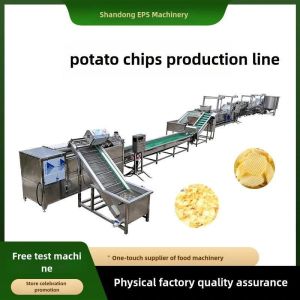
The French fry and potato chips production line is a sophisticated
and automated system designed for the efficient mass production of
these popular snacks. It begins with the sorting and washing of raw
potatoes to ensure uniform quality. In the French fry line,
potatoes are peeled, cut into strips, blanched, dried, and then
fried to achieve the desired texture and taste, with optional
seasoning and freezing for extended shelf life. For potato chips,
the potatoes are sliced into thin rounds, washed, fried, and
seasoned before packaging. Both lines prioritize quality control at
every stage to maintain consistency in product size, color, and
flavor. The entire process is streamlined to produce large
quantities of high-quality French fries and potato chips for the
market.
Detailed Photos

Application
 A combined production line for both French fries and potato chips
involves similar stages with specific variations tailored to each
product. Here's an overview of the process for each:
A combined production line for both French fries and potato chips
involves similar stages with specific variations tailored to each
product. Here's an overview of the process for each:
Common Initial Steps
1. Receiving and Storing Raw Potatoes: Potatoes are delivered and
stored in a designated area. Quality checks are performed to ensure
the potatoes are suitable for processing.
2. Washing and Peeling: Potatoes are washed to remove dirt and
debris, then peeled. Mechanical methods can be used for peeling,
depending on the desired product quality and processing speed.
3. Inspection: Potatoes are inspected for any defects or unsuitable
pieces, which are removed from the processing line.
Production Line for Potato Chips
1. Slicing: Potatoes are sliced into thin, uniform slices. The
thickness can be adjusted to produce various types of chips, such
as kettle-cooked or standard thin chips.
2. Rinsing and Blanching: The slices are rinsed to remove excess
starch and then blanched to improve color and texture.
3. Frying: The potato slices are fried in hot oil at a controlled
temperature until they reach the desired crispness.
4. De-oiling and Cooling: Excess oil is removed, and the chips are
cooled to prevent condensation and maintain crispness.
5. Seasoning: Chips are seasoned with salt and other flavorings.
This is often done using tumblers or seasoning drums.
6. Packaging: The seasoned chips are packed into bags or other
packaging materials, ensuring they are sealed and airtight.
Production Line for French Fries
1. Cutting: Potatoes are cut into strips of the desired size and
shape, such as shoestring, crinkle-cut, or steak fries.
2. Blanching: The cut potatoes are blanched in hot water or steam.
This step helps to partially cook the potatoes, remove excess
sugars, and prevent discoloration.
3. Drying: The blanched fries are dried to remove surface moisture,
which helps to achieve a crispy texture during frying.
4. Frying: The fries are fried in hot oil at a precise temperature
to develop a crispy exterior while keeping the interior fluffy.
5. De-oiling and Cooling: Excess oil is removed, and the fries are
cooled.
5. Freezing (if applicable): For frozen French fries, the cooled
fries are quickly frozen to preserve their texture and quality.
6. Packaging: The fries are packed into bags or boxes for
distribution. For frozen fries, packaging is done in a way that
prevents freezer burn.
Final Steps for Both Products
Quality Control: Quality checks are conducted throughout the
production process to ensure the final products meet the required
standards.
Storage and Distribution: The finished products are stored in a
warehouse before being distributed to retailers.
The machinery and equipment used in these production lines are
designed to handle large volumes of potatoes and ensure consistent
quality. Automated systems are often employed to maintain
efficiency, reduce manual labor, and ensure food safety standards
are met.
After Sales Service
Pre-sale service
24 hours online to answer questions you want (Via WhatsApp, WeChat,
Trade Messenger, Skype, etc.), or you can send an email, we will
revert soon.
Sales Service
1. To provide customers with a new and high-quality machine.
2. Provide pictures the customer desired about the machine during
production, in the warehouse, and before transport.
3. Both parties determine payment.
4. Customers to choose the mode of transport.
After-sales service
We offer a one-year warranty for the whole machine except easily
broken parts, Providing the spare parts with a favorable price all
the time and 24-hour online service.
The voice from the customer

Company Profile

EPS Machine Company is a leading manufacturer of high-performance
food processing equipment, including food-forming machines, coating
lines, frying equipment, and fruit and vegetable washing systems.
With over 1,000 projects and a skilled design team, we offer
energy-efficient, reliable, and sustainable solutions. We
prioritize quality, using top components from Germany and Japan,
and adhere to ISO9001 standards. Our philosophy, "Efficient,
Professional, Sustainable," drives our focus on innovation and
eco-friendly practices. Committed to customer-centric service, we
aim to enhance global food solutions with advanced technology and
excellent service.
FAQ
Q1: How long is your delivery time?
A1: Generally, it will take 15 to 30 days after receiving your
advance payment. The specific delivery time depends on the items
and the quantity of your order.
Q2: What's your terms of payment?
A2: By Wire Transfer (T/T) and other methods. Please contact our
customer service for specific details.
Q3: Where is the market for the product and what is the market
advantage?
A3:Our market covers the almost whole Europe, America, Asia, Africa
and exports to more than 50 countries.
Q4: How does your factory do in terms of quality control?
A4. Quality is priority.We always attach great importance to
quality control from the very beginning to the end of the
production. Every product will be fully assembled and carefully
tested before it's packed for shipment.